That is not a bad memory — a name is the one thing about a person that means
nothing. Namaegao trains exactly that moment: meet, wait, recall. Free, in your browser or on Android.
Free · no accountSolo or 2–12 playersReal photographsResearch-based drills
🙂 Face card🔖 Call the name
A game takes 3–5 minutes. One phone, everyone around it.
01 — WHYYou recognize the face. The name is gone.
Four seconds after an introduction, the name is gone — yet you would recognize the
face in a crowd a year from now. That is not a bad memory. A name is the
one thing about a person that means nothing. A job, a hometown, a
story they told — those all connect to what you already know. The name is an
arbitrary label, and it arrives alone.
Memory research has a clean demonstration: the same word, presented as an occupation
("he is a baker"), is remembered far better than when presented as a surname
("Mr. Baker")[McWeeny et al., 1987]. The sound is identical. What changed
is whether the word meant anything. In other words, forgetting names is not a
character flaw — it is what memory does with meaningless material.
Namaegao turns the fix into a game: attach the name to something meaningful, wait,
then recall. Repeat at expanding intervals until the name sticks.
02 — MODESThree ways to practice
📇
Card Memory (business)
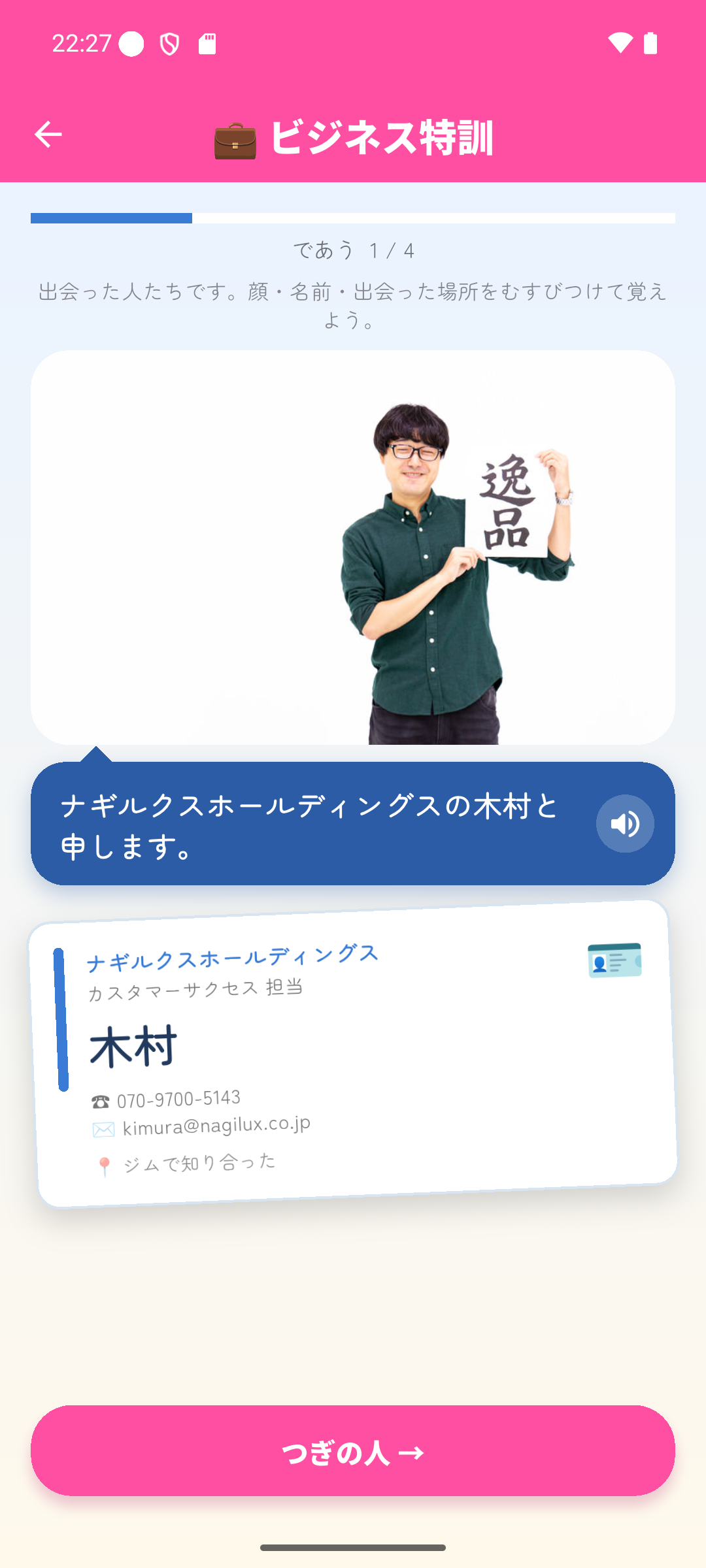
Several people introduce themselves with a business card. Time passes — then you
have to say who was who. Closest thing to a real networking event, without the risk.
🃏
Name Call
The main game mode: face cards and name cards, solo or with 2–12 people around
one phone, plus online matches.
🙂
Face Notes
Add photos and names of the people you actually need to remember — colleagues,
clients, classmates. The ones you miss come back on a later day, automatically.
03 — SCREENSScreenshots
Card Memory: introductions with cardsLinking faces to namesHome screen
04 — SCIENCEWhat the research puts in the design
Retrieval practice — being tested on material beats restudying it for long-term retention, one of the most reliably replicated findings in the field. Reviews ask you to produce the name, not reread it.
Spaced repetition — names return at expanding gaps (1, 3, 7, 14, 30 days) and only missed people come back sooner.
A built-in delay — answering instantly proves nothing; you are reading short-term memory. A "time passes" step sits between meeting and recall.
Four plausible options — quizzes are padded with realistic decoy names, because a two-way guess is right half the time when you know nothing.
Retention counts from the second encounter — the report separates "got it right" from "still knew it next time".
Real photographs — the English version uses faces of people who do not exist (generated), so practice is closer to the real task — and no one's portrait is used without permission.
What we do not claim: playing a memory game has not been shown to make
you generally smarter, improve unrelated cognitive abilities, or prevent or treat any
medical condition. What practice can reasonably be expected to improve is the specific
skill you practise — linking faces to names and retrieving them later.
See what the research actually says.
05 — WHOWho it is for
Sales, support, and anyone whose week is full of new faces
New hires and students facing a whole team or class at once
Conference-goers and community volunteers who keep saying "sorry, we've met"
Anyone who wants to get names right, including unfamiliar ones
People interested in memory techniques with sources, not folklore
INDIA — 🇮🇳Made for name-dense moments
India runs on names. A new office floor in Bengaluru, a
first-year engineering batch, a family wedding where the guest list crosses two hundred. Namaegao
works offline, costs nothing, and runs on the phone you already have.
🎓 First day on campus or at a new job
Forty introductions in one week is normal. Practise tonight what you heard this morning —
the ones you miss come back tomorrow, then after three days, then a week.
💼 Consulting, sales, and client teams
Card Memory mode rehearses the exact shape of a client meeting: introductions, a gap,
then "remind me who was heading analytics?"
💍 Wedding season
Two hundred relatives, half of whom already know your name. Face Notes keeps the score
so the second meeting goes better than the first.
🌐 Names across languages
Getting a name right in a language not your own is a skill — practising recall beats
hoping. Works fully offline, so patchy bandwidth is fine.
Because names are arbitrary labels — the one kind of information about a person
that connects to nothing. More in
why you forget names instantly.
Can I practise on people I actually know?
Yes. Face Notes lets you add photos, names, and details of real colleagues and
quiz yourself. Missed people return on a later day.
Is it free?
Yes. The web version plays in your browser with no install; the Android app is on
Google Play. It contains ads, but the training itself is free.
How long does a session take?
A game runs a few minutes. Because the second-day recall matters more than the
first evening, the habit that pays is short sessions spread over days — not one long
cram the night you meet people.
Where does my data go?
Photos and names you add in Face Notes are stored on your device. Uploaded photos
are not sent to any server. See the privacy policy.
07 — GUIDESGuides on remembering names
Short, research-based guides — in English and Japanese.
The reason I wanted to make a game about faces, names, and naming in the first place is that I
love a Japanese card game called Nanjamonja, made by a shop called Sugorokuya,
and have played it many times. Namaegao has its own original rules and content —
it is not an imitation of Nanjamonja — but the idea came from how much fun there is in
naming something and trying to recall it later.